
Scott County Court Records After Arrest
Arrest, booking, roster, and court case records are separate. A person booked into Scott County Detention Center may appear on the jail roster before the formal court record is easy to find. The roster may use booking-level charge words, while the prosecutor and court determine the filed charge that becomes part of the case record. Misdemeanors and violations in Scott County are prosecuted by the Scott County Attorney, Cam Culbertson. Felony cases may move through probable-cause review, grand jury action, indictment, and Circuit Court.
District Court handles misdemeanors, violations, traffic cases, arraignments, felony probable-cause hearings, domestic-violence matters, juvenile matters, probate, and lower-dollar civil cases. Circuit Court handles felony criminal cases and other higher-level matters. For custody and booking details, use Scott County jail inmate records. For booking photos, use the Scott County jail mugshots page. For filed charges, court dates, and case-copy requests, use the Kentucky Court of Justice and the Scott County Circuit Court Clerk.
The Kentucky Court of Justice docket search image is linked from the official Kentucky docket portal.
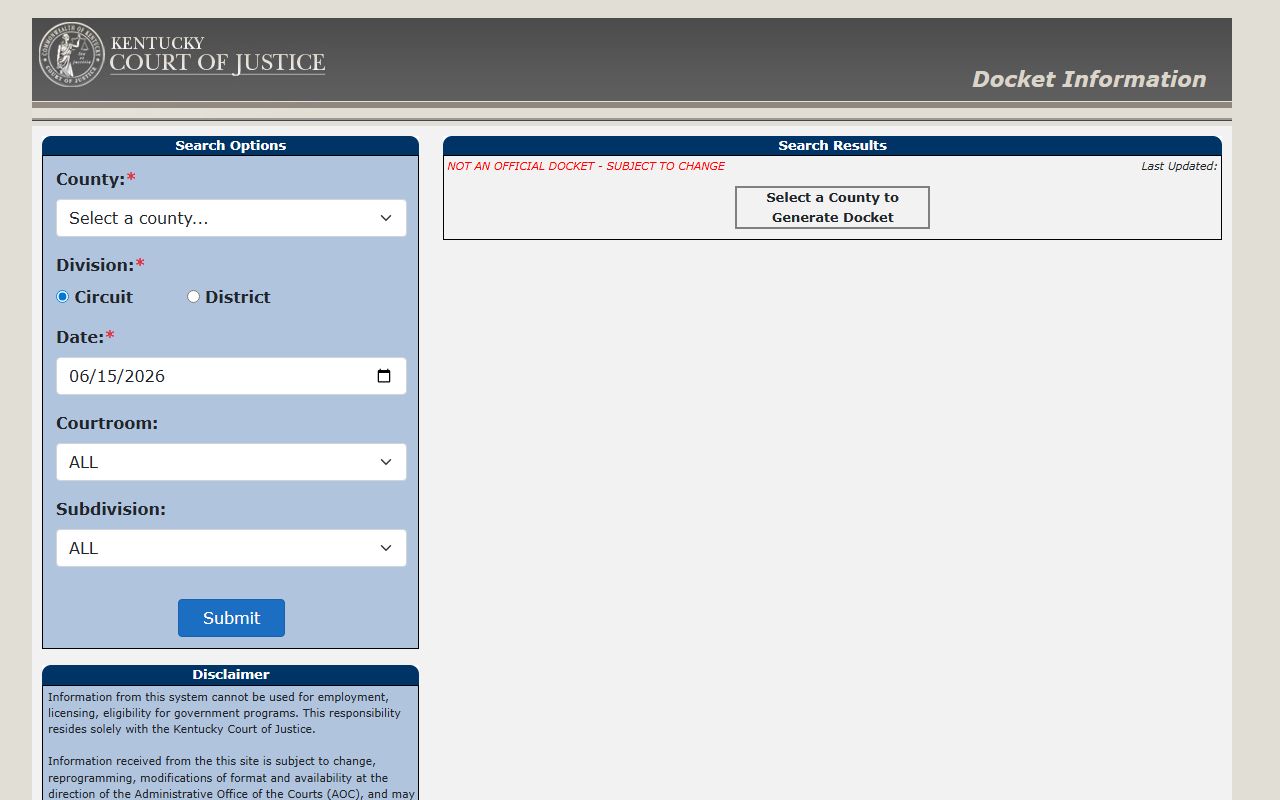
The docket portal is a search aid, not the final certified record. The portal itself warns that docket information is not an official docket and can change.
Scott County Court Contacts
Scott County court records are routed through the Scott County Justice Center and the Kentucky Court of Justice. The Circuit Court Clerk is Tina M. Foster. The clerk's office is the starting point for copies of case records from Scott County cases. Older or archived records may require State Records Center routing, and that office requires case and file locator numbers rather than a name-only search.
Scott County Justice Center
119 N. Hamilton St.
Georgetown, KY 40324
502-863-0474
Fax: 502-863-9089
Scott County Attorney
County Attorney Cam Culbertson
502-863-7870
Misdemeanor and violation prosecution in Scott County.
The Kentucky Court of Justice Scott County page lists the Justice Center, clerk contact details, fax number, and court schedule links. The Scott County Attorney criminal prosecution page says the office prosecutes misdemeanors, violations, DUIs, traffic offenses, assaults, thefts, and minor drug offenses.
Find Court Records After Arrest
The docket portal searches by court division, county, date, courtroom, and subdivision. It is useful when the hearing date is known or when a person has a pending court date soon after jail booking. Select Scott as the county and choose District or Circuit based on the type of case. District Court is the likely starting point for misdemeanors, traffic matters, arraignments, and felony probable-cause hearings. Circuit Court is the felony trial court after a case reaches that level.
| Field Label | Type | Required | Options / Format Notes |
|---|---|---|---|
| Division | Radio or dropdown | Required | Select Circuit or District. |
| County | Dropdown | Required | Select Scott for Scott County. |
| Date | Date | Required | Use the known or expected court date. |
| Courtroom | Dropdown | Optional/default | ALL is shown as an option. |
| Subdivision | Dropdown | Optional/default | ALL is shown as an option. |
| Submit | Button | Not applicable | Generates the docket view. |
- Check the jail roster first if the person is still detained, and note the name, intake date, and booking charge wording.
- Open the Kentucky docket portal, select Scott County, and choose District or Circuit division.
- Search the relevant hearing date. If the date is not known, call the Circuit Court Clerk for case-record routing.
- Compare the docket charge wording with the jail roster wording because booking labels can differ from filed charges.
- Request copies through the clerk or the Kentucky Court of Justice court-record request process when a docket view is not enough.
Charges Filed After Arrest
After a Scott County arrest, the court record begins with a charging document. The document type depends on the charge level and the procedural stage. A complaint can start many criminal cases. An information is a prosecutor-filed charging document used in some cases. An indictment is returned by a grand jury, most often in felony practice. These documents are not the same thing as the jail booking entry, even when they describe the same event.
| Document | Who Uses It | Common Role | Scott County Context |
|---|---|---|---|
| Complaint | Officer or prosecutor | Starts a case with sworn charge allegations. | Common in misdemeanor, violation, traffic, and early felony proceedings. |
| Information | Prosecutor | States formal charges without a grand-jury indictment where allowed. | May appear after prosecutor review or waiver steps. |
| Indictment | Grand jury | Formal felony accusation returned after grand-jury action. | Felony matters may move to Circuit Court after indictment. |
A booking charge can be amended, reduced, dismissed, or replaced as the case proceeds. The filed court record controls the legal case, while the jail record controls custody status.
Scott County Charge Status
Charge status is the court record's way of showing where each count stands. One case can have more than one charge, and each charge can follow a different path. A misdemeanor theft charge, a DUI charge, and a traffic violation may not end at the same time or in the same way. A felony charge may begin in District Court for probable cause and later continue in Circuit Court if indicted.
| Status | What It Means | How to Read It |
|---|---|---|
| Pending | The charge is still open. | Check the next hearing date and bond conditions. |
| Amended | The charge wording, level, or code changed. | Compare the current charge to the original booking label. |
| Reduced | The charge was lowered to a less serious offense. | Look for plea, order, or prosecutor action entries. |
| Dismissed | The court ended that charge without a conviction on that count. | Other counts in the same case may still remain. |
| Convicted | The person was found guilty or entered a guilty plea. | Review the sentence, fines, probation, or jail credit entries. |
Bond After Jail Arrest
Bond is part custody record and part court record. Scott County Detention Center publishes detailed bond rules for the jail side. A person posting bond must be at least 18 and have a valid driver's license. Bonds requiring money must be paid in cash at the jail, up to a maximum of $10,000. The jail says inmates can be bonded out 24 hours a day, seven days a week, but a court order, hold, detainer, or no-bond status can still prevent release.
| Bond Type | How It Works in Scott County Records |
|---|---|
| Full Cash Bond | The full amount must be paid in cash if the court allows release on that bond. |
| 10% Partially Secured Bond | Only 10% of the bond is paid in cash. |
| Unsecured / Surety Bond | The court chooses a signer, and no money is required at release. |
| Section A or C Alcohol-Intoxication Bond | Local jail rules describe sign-out options for alcohol-intoxication-only cases, including self-release after 7 hours and 50 minutes for Section C. |
| Property Bond | Handled at the Scott Circuit Clerk's office, not at the jail, Monday-Friday, 8:30 a.m.-4:30 p.m. |
Bond text in the jail record should be checked against the court case. A judge may change bond, add conditions, or order detention. A hold from another county, state parole or probation authority, federal authority, or immigration authority can also affect release, but only rely on a specific hold when it appears in an official record or is confirmed by the jail or court.
Warrants and Court Records
No official active-warrant database for Scott County was found in the reviewed county, sheriff, jail, or court sources. Third-party warrant lists should not be used as the authority for a Scott County arrest or court record. The practical channels are the Scott County Sheriff's Office at 502-863-7855, Georgetown Police Department at 502-863-7826 for city-police matters, the Scott County Circuit Court Clerk for case or bench-warrant questions, and SCDC if the warrant has already led to a jail booking.
An arrest warrant authorizes an arrest. A bench warrant is issued by a judge, often for failure to appear or violation of a court order. A search warrant authorizes a search of a place or item and is not an inmate record. A fugitive warrant or hold may involve another jurisdiction. When appropriate, non-exempt warrant or case records may also be requested through the Scott County open-records request process.
Charges vs Convictions
A charge is an accusation. A conviction is a court outcome after a guilty plea, verdict, or other finding that creates guilt on that offense. The Scott County jail's inmate lookup page warns not to confuse charges with convictions, which is especially important when reading court records after a jail arrest. A person may be booked, charged, and later have a charge dismissed or reduced.
| Point | Charge | Conviction |
|---|---|---|
| Meaning | Formal allegation that an offense occurred. | Final court finding or plea establishing guilt. |
| Timing | Appears early after arrest and prosecutor filing. | Appears after plea, trial, or final adjudication. |
| Proof Level | Probable cause or charging standard. | Beyond a reasonable doubt or admitted by plea. |
| Record Use | Must be read as pending or unresolved unless disposed. | Can affect sentencing, probation, fines, custody, or DOC placement. |
Sealed and Expunged Records
Kentucky open-records law favors public access, but not every criminal or court record remains open in the same way. KRS 61.871 states the policy of free and open examination of public records. KRS 61.872 gives Kentucky residents inspection rights unless an exception applies. KRS 61.878 lists exemptions, including categories that can matter to law-enforcement and privacy-sensitive records. Expungement is a court process, and a person seeking to clear or restrict a record should use Kentucky's court process rather than relying on roster removal alone.
| Point | Sealed | Expunged |
|---|---|---|
| Public View | Hidden or restricted from ordinary public access. | Treated as removed from public record access under the court order. |
| Record Source | The record may still exist in restricted court or agency systems. | The court order controls how agencies handle the qualifying record. |
| Common Trigger | Privacy, juvenile status, protected case type, or court order. | Dismissal, acquittal, or eligible disposition under Kentucky process. |
| Practical Step | Ask the clerk what order or rule limits access. | Follow the Kentucky expungement process and then contact affected agencies as needed. |
For booking photographs, KRS 61.8746 restricts certain commercial uses of booking photos or official inmate photos when removal requires payment. It does not mean every booking photo must be posted online, and it does not replace the court expungement process.
Request Scott Court Records
The Kentucky Court of Justice court-record request page says the Office of Circuit Court Clerk in each county is the starting point for requesting copies from cases in that county. For State Records Center files, requesters need case and file locator numbers. Requests may be sent to state.records@ky.gov or routed by phone at 502-564-3617, but those archived files cannot be searched only by name or Social Security number.
KRS 61.880 requires public agencies to determine within five business days, excluding weekends and legal holidays, whether they will comply with an open-records request and to explain denials. Court records have their own court routing, so do not send a court-copy request to the jail unless the record sought is truly a jail record.
Important: Do not use casual court or jail lookups for employment, tenant, credit, insurance, or other FCRA-covered screening decisions.